Showing posts with label parenting. Show all posts

Friday, 3 February 2012

Good Fortune

full moon - EXPLORED 19/11/2011

A while back, a friend suggested I write something about Fruition - something about clarifying the purpose of the book, or my intentions, or something. Anyway, here goes.

First up - Fruition is all about that classic question –
'If you could live your life over again, knowing what you know now, what would you change?'
I've thought about that a lot. Unlike Piaf I think I can honestly say I regret almost everything. One period in my life especially that I've wished and wished I could go back to and do again is my late teens and early twenties. What a mess!
It’s a period that still haunts me. I could so easily have become one of those sad individuals in his thirties, still living with his parents, with his fish tanks or his model soldiers, unemployable and spurned by women. But I am aware that, under slightly different circumstances, with a less tolerant family, things could have been much worse. I don't think I would ever have killed myself (I didn't have the will and I was always oddly hopeful) but events could have spiralled. I was never into dangerous behaviour, drink or drugs, but I could have just let things fall apart. I could have had an accident, or, without a home to go back to, I could have simply failed to hold down a job, to make friends, to pay the rent. I could imagine that happening to me. In Fruition, this is where Gabriel Fortune’s story starts.
One thing I didn't want the book to be was autobiographical. If I found myself trying to faithfully describe something that actually happened, or a place or person that actually existed, I'd have to chuck in some occurrence or characteristic from somewhere else, just to force myself to create something new. Trying to describe what actually happened to me sounds like an awful chore and what I've written above about it is as far as I want to go with that here. The themes though - of how a person can get into such a mess without resorting to the predictable narrative devices of violence or addiction interests me. It happens all the time - people simply fail to thrive. Without any dramatic gestures they simply fall away and hardly anyone even notices they’re gone. I was very influenced in this by a book called Stuart: A Life Backwards - not so much because of the character (who's life included plenty of violence and addiction) but because its reverse narrative put his earliest experiences (and hence the explanations for what happened) at the end of the book and hence provide a thrilling conclusion. I'm not sure how well I've achieved it, but a question I'd like the reader to be asking almost from the beginning is How on earth does a person end up like this? What has happened to him? The usual suspects - childhood neglect and abuse are hinted at from early on but again I wanted to avoid the usual. Sometimes it is something far less obvious - something that seems ordinary, or at least unexceptional, but which, under certain circumstances can contaminate everything. The full explanation, in as far as there ever is such a thing, is not revealed until book 4.

Books 1 and 2 are basically alternative versions of the same lost life. Books 3 and 4 are about how he changes that. The overall story is not about perfectibility but about the possibility of change. In many ways it is a long meditation on another classic question – ‘What is The Good Life?’ This inevitably (to me) raises all sorts of exciting philosophical and political questions and I give Gabriel plenty of opportunity to debate with the various characters he meets, especially on the boat. On the other hand I’ve (perhaps surprisingly) hardly touched on questions of God and spirituality. The fact that when they die everyone suddenly discovers that the afterlife is nothing like what they expected makes the whole subject somewhat moot and that’s quite subversive enough in my opinion. Ultimately though, Gabriel’s real preoccupations are far less cerebral. Mainly he wants to know how to make a living without selling out (the quaint old 20th Century notion that doing as well as possible and making as much money as possible aren't the same thing), and in particular he wants to find a woman to love. Fruition is very much a love story, although this doesn’t become obvious until book 2 and it is not resolved until the very end. Childhood and parenting are also major themes throughout the book. Remaining anti-autobiographical though, the events in his early life - the descriptions of his family and home, are completely different to mine. I wanted to see what it would be like to have sisters instead of a brother, and to be much younger than everybody else in the family (an unplanned late pregnancy) as my mother was in her family. I couldn't resist using the house we lived in though because it was just such an amazingly ugly old place. Gabriel wants to become a painter where I wanted to be an ecologist. We both like gardening though.

My warped idea of reincarnation is of course just a narrative device, not a belief system of mine (although it seems no less plausible than the alternatives. Who's to tell?) I'm always intrigued by the things people come to believe in and I made this system up partly as a sort of mischievous 'See? I can play that game too'. I also wanted The Afterlife to be a whole huge other world – one that would involve an immense journey overland, alone or with just a few companions. This had two purposes - one was to provide a place where Gabriel could think about and talk about his lives through a sort of quasi-therapeutic conversation. (I like books that use therapy as a device to tell us what our hero thinks is going on.) The other purpose was to give Gabriel an enormous and extraordinary landscape to travel through – and one that doesn't work by the usual rules. Having this apparently limitless new world to play with meant I could set my characters in the landscapes I'd had swimming about in my brain for decades - places I'd been to and stories I'd told myself to stop the 'real world' colonising my mind completely. As Gabriel says in book 1:
“Everybody said I ... was always ‘off in my own little world’, but they were wrong. It wasn’t a little world at all. It was enormous. There were landscapes and characters they wouldn’t even have come across in their weirdest dreams. I spent a lot of time getting it all down on paper – writing about it or drawing and painting. I did some huge scenes – part map, part landscape, with gargantuan shaggy beasts and archaic birds, engaged in incomprehensible behaviours among misshapen trees and alien fungi. Offshore, vast dead-eyed fish and primitive whales turned among forests of coral and kelp. I don’t know where it all came from. Nobody ever asked me about it. Dad and mum just shook their heads and tutted and went away. In my world there were settlements too, some of exquisite architecture and peopled by gentle and tolerant souls. Others bristled with armaments and dripped with pollution. And always there was a woman, and she looked past all the crap and saw me as I really was, and we’d be happy together.”
It’s difficult to pin-point any direct literary influences here but one unlikely source was Peter Jackson’s three films of The Lord of the Rings (I find the books unreadable.) They have just this sense of the tiny figure moving through a huge and ancient landscape. There’s a lot of ecology in Fruition too. The animals and plants we find there are all real or plausible, though they might not appear so to the non-biologist.

At the same time I hope my book doesn’t fall into the standard genres of 'fantasy' or 'science fiction' or 'horror'. I have trouble with these sorts of books because often they don't seem to feel the need to be even a bit rooted in real experiences and emotions, hence they can have anything happen and I’m left not caring. To really feel the otherness of these strange places, I think we need to be regularly reminded of what it’s like to live in normal everyday life. I always liked the wardrobe device in the Narnia books but I felt they should have gone back and forth more, to refresh the feeling of wonder. Doctor Who seems to amaze someone with the Tardis every other episode.
On the other hand, I find the entirely 'realistic' novel - historical or contemporary, just too pedestrian for words. They say that the difference between fact and fiction is that fiction must make sense, but I’m not so sure. Life does not always make sense, and fiction should be able to reflect that. I hope any books I write (I have two more on the way - one almost complete, the other still in my head) will always feel as if they could be partly dreamed or hallucinated but always set alongside everyday life. The novelist should not feel the need to explain every incongruity. Children's books don't seem to feel this need to tie up every loose end. (I sometimes like to think of Fruition as a children’s book for adults. Is it just me or do modern authors seem very reluctant to make stuff up?) ‘Magic realism’ always seemed too self-consciously clever. Something’s missing... Perhaps I don't read as much as writers are supposed to but I so rarely find anything I want to read these days, unless you count non-fiction, which I read a lot. That feels like a terrible thing to have to admit. Mind you, I don't like most of the music I come across either but I can usually find something new to listen to. Perhaps I'm just out of the loop.
I think I'm a very 'visual' person, and very affected by music too - Fruition seems very connected in my mind to the Fauré Requiem (which will definitely be the record I'll be running into the waves to save when they have me on Desert Island Discs. Gabriel Fortune - Gabriel Faure? I hadn't noticed that before. How curious.) TV and film seem more free to invent things without going all post-modern on us (I particularly like the work of Terry Gilliam, David Lynch, and Jos Whedon.) On reflection, I think the books that have had the most (subconscious) influence on Fruition would probably be Cider With Rosie, The Time Traveller's Wife and Moominland Midwinter.

I've also become discouraged from reading other people’s books by the fact that so many seem to have such a knowing, world-weary take on the human condition, where nobody really seems to like anyone very much and there's nothing anyone can do to change anything. (I'd love some recommendations to prove me wrong on all this by the way.) I really wanted to give Gabriel not exactly a happy ending, but something hopeful – something redemptive. I wanted him to find himself among friends in a way he never did in life. Although personally I’ve always found people difficult I do believe in generosity and humanity when I think a lot of writers don’t. Apart from anything I actually don’t think their pessimism is very realistic. It feels lazy and smug – why bother to try when everything will probably go badly anyway? Better to just enjoy the spectacle. So I also wanted to avoid what I suspect would be the normal cynical ending where he would find that no matter how he tries to change, something new inevitably springs up to thwart him. How drab. How very predictable. At the same time of course there can be no simple, clean happy-ever-after, but those aren't the only two options.
In short, what I wanted to write was the book that I’d always wanted to read but could never find.

So there came a time when my embryonic career in ecology was aborted and I was about forty years old and I had all this in my head. I looked at my life and realised that although I wasn't exactly old, I really was at the end of my main attempt at life. I didn't know what I was going to do next - I was single, homeless and unemployed again.  Although I guessed it was some way off I had a very strong sense of the end of my life being out there somewhere. It wasn't a bad feeling. I just knew it was there in a way that I hadn't before. So this book is also about death, but not in a morbid way (or only in the literal sense.) I don't believe in any Afterlife but I'd quite like to think that when death comes I'll find myself in a sleeping bag in a deck chair on a boat heading out into a frozen ocean...

Tuesday, 9 August 2011

It's the end of the world as we know it... (and I'm feeling a bit tired, to be honest)

Looting at Wood Green.
I feel the urge to comment on what's been going on in London (and last night in other British cities) of late.
I live in a leafy Sussex village so not exactly qualified, and yet...
Part of me, the deeper more natural response, feels a deep foreboding. No Silly Season this year. My mind seeks to make sense of it - to find a pattern. With the chaos in the global economy and the corruption in our media, everything seems to be falling apart. It can only be a matter of time.
The other, more rational part of me though, wants to know if this is really anything new. It's my attempt at an antidote to Daily Mail style knee-jerk outrage - to see the broader pattern, look for counter examples. For a start, it's irrational to expect that extreme news stories will be evenly spaced through time. Sometimes they come along several at once. And haven't we seen all this, and worse, before, at other times, in other places?

Let me, for a moment, indulge the first part. There could be something big and dramatic going on. The thing that immediately pops into my mind is that there has been over the last twenty to thirty years a loss of a sense of morality - the idea that there are things you simply do not do, no matter how much you may feel you can get away with them, and that conversely, some things are simply right and worth doing whether they make economic sense or not. So -
The markets are in turmoil because the only thing that mattered to the traders and investors was making as much money as possible as quickly as possible, irrespective of what was being bought and sold. The media is in trouble because the only thing that counted was selling papers, and it didn't matter how the 'stories' were obtained or whether they were worth telling. What's happening in English city centres right now is happening because people have realised that if enough of them turn up in one place at one time and are prepared to be violent, that they can get away with pretty much anything. Civilised society, for all its faults (see pretty much any of my other postings) works not because there's an armed policeman on every corner but because people generally agree to go along with it. Without that agreement nothing matters except what you can get away with. And if you get caught? Well - you wouldn't want to be seen as 'Risk-Averse' would you? It's no different to rock-climbing, or snow-boarding, or market trading.

But is this anything new? Haven't there been crises, scandals and riots before? Not on this scale perhaps? Maybe. The Radio 4 programme The Long View is an especially useful resource here. There is always an historical precedent it seems. Go back a bit and you can always find something uncannily similar going on somewhere. Plus ça change, plus la même bloody old chose as I always say.

Part of me wants this to be different though. I don't want the world to be going to Hell in a wheelie bin but there's something seductive about it - The End of Days, partly because, being nearly 50, I probably won't be around to witness the denouement. Actually I'm much more deeply distressed by what's happening to the environment - for example in Brazil and China in the name of economic growth. I watched Avatar again over the weekend and was in tears, not because of what was happening on screen so much but because I know that huge swathes of Amazon rainforest will soon be under water due to a new dam they're building and the fish will no longer be able to migrate and breed and the locals will no longer be able to sustain themselves as a result, the way they have for generations. And yet it does feel like part of the same thing. The Brazilian government has decided that making money is their priority and everything else - wilderness, biodiversity, indigenous cultures, are just not definable, not measurable, not valuable enough to count. 'But what of the favelas?' you might ask. 'What about the poverty, the lack of proper jobs, the lack of a decent place to live?' but we all know there's more than enough for everybody, still, in the world, as it is. It's just not shared out properly. The Brazilian government says it wants to deal with the poverty, but only if it means not disrupting the wealth. That's the bottom line.
There was some finance pundit on the radio yesterday (I didn't catch his name) commenting on the power, or lack of it, of governments to deal with the economic chaos. He seemed to see The Market as this wonderful perfect democracy - where ordinary people could spend or invest their money as they wished, on what they wanted, expressing in the purest form, how they wanted the world to be run. Government was therefore redundant. But in that case, what of those with no money, or very little? Not that long ago the only people allowed to vote in parliament were the wealthy landowners, and then they let the wealthier merchants join in.
I might be able to vote with my cash whether to buy Freedom Foods chicken breasts or the factory-farmed alternative, but this other guy can choose whether to buy BSkyB Ltd or not.
And what about things that don't have a monetary value, and yet which are intrinsically worth having anyway, whether you have the money to buy them or not? (I know - such things are anathema to The Market.)

I could blame the parents. For all the good it did, since the sixties, parents have not seen it as being their job to teach their children right and wrong. 'Who are we to tell them what to do?' they say. 'What right have we?' And they feel so guilty for not being at home as much as they'd like, and for getting a divorce, so they want to be 'nice' to their children no matter what they do, and don't feel they are really justified in being in any way 'nasty'. (I actually have a lot of time for Supernanny popularising the concepts of 'Firmness' and 'Boundaries' but that's for another topic.) The pre-sixties authoritarianism where the husband and the father (the priest, the teacher, the policeman) enjoyed his arbitrary power I suspect stands as the bogeyman alternative - one none of us, quiet rightly, want to go back to. So morality is seen as something relative - a matter of opinion. We're all entitled to our opinions and the childrens' (because they are natural and unspoiled, until we get our greasy mits on them) are more valid than most.
But children are not perfect beings. They have no in-built morality of their own. Children, like other animals, are naturally amoral, selfish, inconsiderate and interested in immediate gratification unless taught otherwise. They don't think 'What is the right thing to do?' They think 'What am I allowed to do?' They don't think 'Is this a good thing to do?' They think 'What will get me the most attention?' They don't think 'Is this wrong?' They think 'Can I get away with it?' Only later on, if at all, does a more detached sense of right and wrong develop, and it has to be taught, like any other skill. That is our job as parents. It is not 'nasty' or authoritarian. It is necessary.

So - you can see where I'm going with this. Is what is going on in Tottenham and Wapping and The City of London a simple result of modern parenting? Are they really just spoilt brats writ large?
Of course not. How much have any of us ever really done simply because it was the right thing to do? How good has parenting ever been, really?
Isn't the magnitude of the chaos just about the size of the organisations - their global reach, or, in the case of the rioters, their ability to communicate via their Blackberries? Isn't it just all about technology and globalisation?
I honestly don't know.

Saturday, 19 February 2011

An Only Child - part 1

Thru'penny Bit
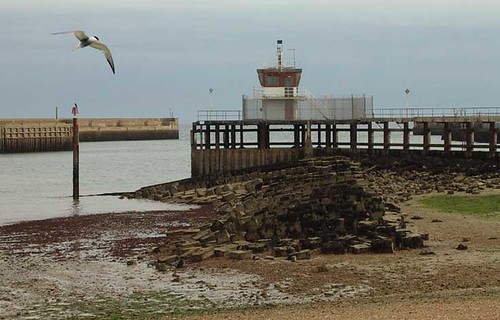
Kingston Beach at low tide
I don't dislike children - contrary to what some may think.
I do dislike it when people are loud and selfish and don't put things away after they've finished with them, and when they insist they know what's going on when in fact they don't. I also have problems with people who make a huge fuss when things don't go their way. The fact that this describes a large proportion of most 'normal' childhood behaviour doesn't seem to bother most people but it's always struck me as odd. Indeed, most adults seem to see it as typical or even healthy and hardly worthy of comment. Why do I feel so differently about it?

I had a pretty good childhood back in the sixties and seventies by most standards. I was pretty content as long as I had some paper and pencils or plasticine or Lego to play with. I was mostly into dinosaurs. I had full and complex relationships with my cuddly toys. I spent hours hunting wildlife (mostly slugs and beetles), digging holes and building camps in the garden - a wilderness of nettles, brambles and raspberry canes and other miscellaneous junk. The soil was full of broken glass from a wrecked greenhouse but I hardly ever cut myself and never seriously. I never played on the lawn. Both the house and the garden were pretty immense by today's standards so it was easy to stay out of sight. I had collections of stamps, seashells, Airfix models, and then tropical fish and house plants (which got me into gardening just before I left home). I spent hours down on Kingston Beach hunting marine life. It was just across from the end of the road. I knew all the little twittens and wasteland around the town and then as I grew I spent a lot of time over the harbour and I walked and cycled as far as Steyning and Ashington. I looked at my dad's books (non-fiction - mostly wildlife) and listened to his music (from Louis Armstrong to Holst, from Westside Story to Tubular Bells). We had cheap camping holidays and big family Christmases. We didn't have a telly for years.
Don't assume from this that I come from a posh background. My dad was an electrical fitter and shop steward at the power station, like my mum's dad before. My dad's dad was a lorry driver amongst other things, and they were all from around Shoreham. Mum did home help and bar work. The big house on Victoria Road, Southwick was cheap because it was a mess. At the time it was cold and dusty and decidedly eerie at night. It was not an attractive house. Back then there was no housing shortage and everyone wanted the new bungalows on the Downs behind Shoreham. Dad fixed the whole thing up himself (with help from friends and relatives) because we couldn't afford to pay plumbers and electricians and carpenters. He learned to do everything himself. Today a three storey, four bedroom house with a lounge and a dining room and a conservatory and probably a third of an acre at the back would be a different matter. Nowadays you'd pay the better part of half a million for it, pull it down and start again.
And don't imagine that Southwick was a picturesque idyll. It has a rather impressive village green and some very venerable buildings near by, but the bulk of the town is fairly anonymous. Travelling from Brighton to Worthing along the coast road you'd hardly know it from all the other places along there - Hove, Portslade, Fishersgate, Shoreham and Lancing. Kingston Beach, which lies within Shoreham Harbour, is a mud flat at low tide with only shallow muddy pools among the pebbles and rubble. There was a remarkable variety of life down there none the less. Back then, without a property boom, demolition sites could sit empty and grow weeds for decades. I hunted grasshoppers and lizards among the rubble and played jungles in the Buddleia and Japanese Knotweed.
It's unimaginable now that a child as young as seven or eight would be let loose in that environment, but I was. I don't think I ever had a major accident. I was very careful. I knew my limitations. One day a man stopped his car near me in Southwick Square and asked me to get in. I simply said no and walked away. Mum had told me, if a stranger spoke to me to go into a shop.
Most of the time I remember I was left to my own devices. I don't remember particularly being lonely or feeling neglected. Sometimes I envied my younger brother because he always had friends around, but then, if he didn't have company he didn't really know what to do with himself. I on the other hand rather resented people interrupting and interfering.
I don't ever remember being deliberately naughty or mischievous. With my family there would have been little point in pushing it so I didn't try. They were not nasty about it - just firm. There would have been no point arguing. I did not live in fear though. I learned to be sneaky. My mum was somewhat anxious and controlling so it was best simply not to ask permission. She preferred not to be distracted from doing what she had to do so it worked both ways. My brother and I never really felt the need to fight and my parents never rowed so we weren't used to raised voices in our house and I still hate to hear people arguing. When we visited friends and relatives their children always seemed to be throwing tantrums or sulking. Everything seemed to be a battle for them and I stayed out of their way. I think a lot of that has to do with the fact that I was the eldest by many years of all the children in our family circle. My brother wasn't born until I was three and we  therefore had very little in common. All our friend's children came along after that. There was no child care or nursery school so I didn't meet another child my own age until I went to school aged five. That's probably why meeting 'normal' kids was such a shock and something I've never really come to terms with.