Monday, 23 December 2013

Possessions

The first thing was that Ellie went missing. Her mother was frantic. It was their first morning in the house – early. The sun was only just coming in the windows low down on the seaward side of the house, casting a honey glow on the white walls. It was going to be another beautiful day and Ellie’s cot was empty and the wooden stairs were steep and the back door did not lock properly and there were miles and miles of marshes all around. She could be anywhere. She could be lost. Poor little round-faced Ellie - adventurous, trusting, self-contained. She might have been taken.

Down through storeys, four in all, airy and white, calling ‘Ellie! Ellie!’ No answer. She must have wandered off again, her sister says, to play with the birds. It wouldn’t be the first time. She must be here somewhere. ‘Ellie!’

Chalk white and pinewood boards, watercolours and prints on every wall - originals. Huge windows. Canvas and tapestry, oak and cedar, silks and batiks, paper shades and rainbow kites, raku pots and masks from Bali, aloes and palms, driftwood and sea-glass. Such lovely things, thinks her mother. They loved this place so very much. So very sad. ‘Ellie!’ she calls, ‘Where are you?’

Father carefully moves a ceramic puffin and a carved wooden dragon aside and crouches in a window niche. He undoes the catch, leans out three floors up and looks down at the ground – lyme grass and shingle, timber and mud, a rotting boat and a rusting bicycle. The single-track road and the shacks further on, the gift shop and the beach cafe. He calls ‘Ellie!’ and a gull comes and holds on the buffeting wind not five yards out, disinterested. He looks up. The October sky all but blue - just a wisp of ice in it. He holds his palm to the white clapboard side. It’s warm to the touch already. Nobody about. ‘Sunday’ he thinks.

The pudgy blue elephant fits in her palm. Ellie holds it up to look as her mother rushes in and gathers her up.
‘Be careful’ Ellie scolds. ‘You’ll hurt Sally.’
Sat across her mother’s lap, one sock on, held tight, her Mother’s tears dot her brushed cotton shoulder. Ellie holds the little round elephant up for her father to see and her sister goes back to her room, muttering.
The girls’ play room. Of course. They hadn’t thought. Four floors down and Ellie so small and yet here she is. Last night’s arrival, too late to explore. Just a quick story and brush your teeth and then all week to play. But no, Ellie couldn’t wait.

Her father slumps in a big orange cushion and looks out the window. It’s still very quiet. A heave of nostalgia – the muslin tent ceiling, the apricot glow. Bears and rabbits, books and crayons, posters and stencils, a tinkling mobile. Warm and alive. And now they’re all gone. Unbelievable.
‘Let me have a look darling’ he says.
The lapis blue elephant is hand-hot soft and sports a saddle and a skull cap in red and white beads, and tiny black beady eyes. ‘What did you say her name was?’ he asks. ‘Sally’ says Ellie and he looks at his wife. Had Ellie ever met her cousin? He doesn't think so.
‘It’s ok’ says the mother. ‘She must have heard us talk about her.’

*

Out all day. Back at five. Tide marks on their feet and salt in their skin. A bucket of cockle shells, a feather and a piece of drift wood with a hole in it big enough to put your finger through. A burger at the café and a paperback from the post office. A sunglasses and fleeces sort of a day. The girls are tired but it’s still light out. Father looks at a shelf of books. Walnut, he thinks. Beautiful. It had only been a few years and the place had been a wreck. His sister Jennie and her husband Mike worked for months non-stop. He had thought them insane but at least it was better than that mouldy flat in the city. What had this place been before? Some sort of warehouse before the river silted up and the curlews moved in, or maybe one of those high wooden structures for drying nets? He’d meant to ask before – before the accident. Jennie and Mike and their two children, Sally and Millie, in a car. So pointless. So stupid. He picks out a book and flicks a page and Mike is there with him, alive, he could swear. He lived for his books did Mike – trains, boats and planes. Jennie was the artist. She is everywhere. He looks about the walls and an orange light floods the room from the west and the shadows move in. ‘Jennie?’ he says, and puts the book away.

‘They’re all still here’ says his wife, in bed. He settles down beside her and looks. The low angled ceiling up under the roof, the girls next door. ‘I can feel them’ she says, ‘everywhere.’
‘They loved this place’ he says.
‘I hope they don’t mind us being here.’
‘Of course not. They’d understand.’

*

In the morning the father goes down to the car and fetches some of the cardboard boxes, a big bundle, flat pack, he can hardly handle them. His wife makes coffee. The girls play in the decomposing rowing boat at the back with toys from the play room. Ellie builds a house for the plastic farm animals from bits of wood to keep them safe while her sister sets up a spa for Millie’s Barbies. Her spa specialises mostly in mud baths. She thinks Millie would like a mud bath. She saw it in a programme once. The ladies came out all clean and relaxed.
The father stands in the middle of the living-room-come-dining-room-come-kitchen that fills the entire third floor and looks at all the things his sister and her husband collected. His wife hands him his coffee and looks too. Two hours later they are still looking. It’s not that nothing has happened. They have tried to take down the pictures, to wrap the china in tissue, to bag up the books and records - Uncle Mike’s jazz and Auntie Jennie’s classical. They just can’t seem to be able to do it. They have tried to prioritise. They have tried to think just one thing at a time, but as soon as they start the room looks so forlorn, so lost without them, as if it just doesn’t understand why its things are being taken away. So they go back where they belong and the father and his wife stand, fresh coffees in hand, and can’t decide what to do. Even the kitchen utensils object.
‘If only we could take the whole house, just as it is’ he says.
‘We’ve talked about this’ she says softly, stroking his arm.
So the things go back to where they live.
As it begins to get dark the girls come in and take the Barbies and the farm animals in the bath with them and wash them scrupulously and dry them and put them back where they live. They’re never so careful with their own toys at home.

Tuesday is the same. The girls play in the mud and the adults try to make a start packing up. The autumn sun illuminates Uncle Mike’s carefully worked and polished banisters and furniture, and Auntie Jennie’s intricate needle-work and neither of them can bear to take any of it away. It’s as if it doesn’t understand why anybody would want to come in and change things. It doesn’t seem to understand what’s happened.

*

It was early on the Wednesday when the break-in happened. Nobody had ever heard Ellie scream so loud. She’d sneaked back into the play room in the small hours and was there when the men got in through the window. Her father appeared in the doorway armed with a golf club and managed to crack one of the intruders hard across the back of the head as he fled. In the quiet aftermath Ellie was understandably shaken in her mother’s arms but more than anything she was worried for her cousins. The intruders had left a terrible mess. Ellie had hidden among the bedding when she first heard the breaking glass and she’d witnessed the kicking about and trampling that went on. She only screamed when they talked about heading up into the rest of the house and her mother told her she was a very brave girl indeed, for raising the alarm but it didn’t console her. Her cousins’ things were torn and smashed – the dressing-up box, and Sally’s paintings. One of the men had stood laughing and weed on them.

The father phoned the police and in the morning the window was boarded up. Ellie, her parents and her sister sat in the lounge with their breakfast drinks. The room in the dim morning light seemed to cower down around them. Ellie said something about Sally being hurt and wanting to go down to help her. Her father said that where Sally was she couldn’t be hurt any more but they all knew it wasn’t true. Jennie was down there in the playroom holding her crying children as Mike stormed about the place - his normally placid face wrung with anger and disbelief, and the entire house and everything in it groaned in pain and humiliation with them - every blanket, every spoon, every paperback book. In every speck and button they lived, and now it had been defiled, their refuge, their nest, their lives’ work, and there was nothing they could do about it.
And they knew it would continue to be defiled. They knew, even if not by criminals there would be estate agents and developers, letting agents and art dealers, house clearers and refuse collectors, come to break it up, break it down, over the coming months, gradually tearing it apart, this thing they had made, that had become them, with their love and optimism, and turning it into just a pile of random stuff to be bought and sold or thrown away. It was impossible.

*

Just before dawn of the following day Ellie, her sister and her mother were standing a safe distance along the road beside their car as their father walked briskly toward them from the house. He was putting something in his pocket. Already black smoke was beginning to waft from the garage door and pretty soon an orange flame emerged too. They stood and watched as, for a while nothing more happened, and then there was a rush of fire from a first floor window and after that the fire spread rapidly up into the rest of the building. By the time the fire engine arrived there was nothing to see but a tower of flames. They all stood and watched together. The girls cried a little but there was no need to explain that this was the only thing to do. They understood completely. The police tried to move them along but the father insisted on staying a little longer just to see that his sister and her family got away safely.


Autumn 2012

Tuesday, 12 November 2013

..except for all the others...

I know I'm not alone in being deeply exasperated with the state of government in the UK at the moment. The recent Brand/Paxman tête a tête is just the latest and most obvious manifestation of this exasperation, but unlike Brand I'm not a great believer in revolution. Any reading of history has got to come to the conclusion that revolutions tend to result in brutality and despotism. In the idealist's mind (and I count myself as still having one of those) there are the brave idealistic young people and noble working people of all races and genders marching, chanting and if necessary manning the barricades and chucking a few bricks until the present administration scurry, tails 'twixt legs, for their safe seats. It's a nice image but unfortunately history tells us that time and time again a 'charismatic' leader emerges and invariably announces that they alone embody the true revolutionary spirit and that anyone who disagrees can, literally, go hang, and there always seem to be plenty of ordinary folk ready and willing to do the hanging. I'm sure there must be exceptions - the Orange and Velvet revolutions perhaps and maybe that's the sort of thing Russell Brand has in mind. I don't think he told us.
But I share his infuriation with the way things are. The Today show has a lot going for it but I mentally switch off for the political interviews with misc interchangeable Govt Wonks (love that word - wonks), when you know that no matter how hard Jimmie MacNaughty probes, the politician is never going to actually say anything meaningful in case it is used as evidence against him at some later date. We know that when politicians promise us things at elections that it means absolutely nothing, and yet we vote anyway, or at least, some of us still do.

My dad - God rest his soul  - used to tell me that there was no point in going on about the state of the world unless you were prepared to get up there and get yourself elected to do something about it. I think he was being a bit naive about this. To stand a chance of getting elected in any capacity you have to have not only some good ideas and a coherent plan but also be confident and articulate, likeable and energetic, and I, like most people, am only, at best, average in those characteristics. Nevertheless I think he was right in his basic faith in democracy (the worst of all possible systems - apart from all the others, according, I think, to Churchill) and that there is little point in going on about politics if you are not prepared to take part in the process. The simple fact is that these politicians which we revile were put there by us - not, I don't mean, because we voted for them so much as because we didn't put someone better up there to be voted for.
The flaw in Brand's argument is that it's all about what they are doing to us, as if we have no way of influencing the system. (For the record I am not actually condemning Brand on this count because he actually is getting up and doing something, and so, I hope, in my own small way, am I, here with this blog.) But this is not post revolutionary France/Russia/Cambodia/China. You won't be arrested if you support a different candidate or start a new party. Obviously it's not easy, but it is possible.

The reason we don't is not because we are apathetic but because we have become pessimistic. I think there's a terrible weariness holding us back. It looks insuperable - to go up against the established public school, Oxbridge, Super-rich establishment. It's all far too complex and very few of us are naive enough to think that any of the simple totalitarian ideologies of the 20th Century are worth resurrecting. If you lived in a place like Zimbabwe or Somalia, the purpose of democracy would be obvious - to end tyranny or chaos. Here in The West it's not so clear. Government has become merely a branch of accountancy, writ large - amoral and inhuman. Milliband et al are terrified of making any pronouncement that might sound like Redistribution or Nationalisation and yet I suspect that there are many of us who would love to hear that stuff. They're terrified not of what the electorate might do but of what Murdoch will make of it, and of how The Market will react. Conversely I suspect that there might be some real support for the UKIP/BNP take on life. Fair enough. Let's have a proper contest - see who wins. Probably the outcome would still be somewhere in the middle but at least it could be a contest fought on real issues - not just maths.
And probably the place will be less stable for a while. There would probably be less economic growth, but if we're going to grow up and take responsibility for ourselves we need to be allowed to make mistakes.

And incidentally, I don't have much problem with a low turn-out. I don't want voting to be mandatory. If you're not interested, by all means, stay at home. I don't want a government elected by people who don't give a toss. A low turn-out should tell the government that something is seriously wrong with what they are offering but I don't want a high turn-out just for the sake of it.

Tuesday, 30 July 2013

Naive Melody


I get rained off work - I write something on the blog. Hence its intermittent nature.

I've been thinking a bit about Housing. It was on the You and Yours phone-in today. I'm not a property owner myself. I briefly had a mortgage with my first wife about twenty years ago - on a tiny ancient place in Lewes, East Sussex, up against the old town walls (2 Castle Rise in case you know the place). It was literally two up two down with a tiny sunless back yard which I filled with plants. There was me and her and her teenage daughter. Her teenage daughter had the only proper bedroom and my wife and I slept in the lounge. I know - it sounds like a perfect disaster waiting to happen doesn't it, especially with such a tumultuous relationship. It was one of those things where everyone, but everyone, could see what was going to happen but didn't like to interfere. Would I have listened? I don't know. I loved Lewes and wanted to live in an old place. Anyway, suffice it to say it got nasty and I moved out. In retrospect it would have made sense to keep tabs on that mortgage instead of just leaving her to it but I felt guilty and she was terrifying and we had her daughter to think of so I just left. Then she moved in with a mate of mine (who also owned an old place in Lewes) and they bought a small holding in France, last I heard. Anyway, the interesting point is that she was a nurse working in an old folk's home, and I was working in a garden centre - and they gave us a 90% mortgage on an old cottage in Lewes!
Just take a moment to process that. This was about twenty years ago. A couple with probably well below average incomes, getting a mortgage for a cottage in central Lewes of all places. And we were shown larger places, and just off the High Street too, but we didn't want the hassle of doing them up!
How things have changed.

I used to go walking in the country a lot when I was a young man - up on the Coombes Road and around Fulking (We lived in Southwick on the coast about half way between Brighton and Worthing) and I always sort of assumed I'd one day be able to live out there or somewhere like it - not necessarily in a very picturesque cottage - just a bungalow perhaps, or even just a hut, with a bit of ground to have a garden, some trees, a few ducks. Now I know that, short of winning the lottery, that's just never going to happen. It simply isn't possible any more. Nowadays, most of southern England is simply out of reach to most ordinary people. My wife and her ex own this place where I am now in a new estate in the Sussex town of Henfield but it's an interest-only mortgage and once the kids leave home (they're 14 and 16, so quite soon) that'll be us - back at the bottom of the property ladder. And neither of us is getting any younger (I was 50 last December, and she's... erm... a bit younger). No wonder she wants to emigrate to Canada, but that's a whole other pot of eels.

I'm not looking for sympathy. There's a lot worse going on in the world.
Does it matter? Or am I just upset at my own silly plight?
I think it does.
In the Radio 4 discussion someone said, as they inevitably do, sooner or later, "Well it's supply and demand innit?" There aren't enough houses so everyone's a bit desperate and the prices go up.
And nobody challenged that logic. They all just accepted it. It's the way of the world. Building more houses would be the only option.
I understand Supply and Demand. In a capitalist economy prices have only a tenuous relationship to how much things actually cost to make or how much real life-and-death value they have, but they have a very direct relationship with how much people are prepared to pay. So something like gold, which has little practical value is expensive because it's rare. Bread though, which is very useful, is cheap because it's easy to make. So far so egg-suckingly obvious. The question arises when something is both rare and useful, nay, essential. What then? And what if something is artificially rare? What if it's only rare because someone has bought it all up? If someone buys up all the posh shoes it doesn't mean everyone else has to go without shoes. They just make more ordinary shoes and those with the money can indulge their whim for overpriced footwear without affecting the rest of us, but that's not how it is with housing. Somewhere (decent) to live is an essential, not a luxury, but it's in short supply. What there is, is disproportionately bought up by those who already have more than they need and... what? The rest of us go without? Or we just impose on the hospitality of those who bought their property before the market went nuts (for which read The Parents) or we claim benefits whereby the government (by which I mean Us) pays the landlords the inflated price their 'supply and demand' has created.

Part of the problem has to be that at some point, I think, in the 80s (the dreaded T word again) housing became more 'an investment' than a home. People bought their properties with a view to selling them for a profit, rather than just, you know, living in them. This view of houses as just a place to stop for a while has been helped along by some very modern lively young things who like to feel they can live anywhere, in a sort of quasi-Buddhist New Age way, not getting attached to mere 'things'. Some of them, understandably, have moved around all their lives and have no real sense of home anyway, but not all of us. Since Tebbitt's 'On Your Bike' speech it has been assumed by the movers and shakers that one shouldn't care where one lives. You just go wherever the work is and if the work moves abroad, well that's just supply and demand again. Start your own business. Be an entrepreneur! What's wrong with you? The Soviets also thought the workforce should be prepared to move wherever the work needed doing. Refugees and asylum seekers have to move wherever they can.

The trouble is I suspect most of us just aren't like that, or would rather not be. I'd be interested to know the figures, but I've come to believe (in flagrant disregard for my parents' thinking) that what I think probably isn't that unusual. I suspect that many of us do care where we live very much, and that for many of us this has a strong connection to the place we were born, where we grew up, and where most of our family and friends are. It's unfashionable to say so, but there you are.
The media don't help. They're used to relocating whenever necessary to pursue their careers so I feel that I'm in a kind of despised minority for being rather attached to where I come from, which is this area around Brighton and the Downs and the countryside beyond. It almost sounds like I might be some sort of Conservative in this respect. Maybe I am. Critics call it Sentimental, which I take to mean 'caring deeply about something I happen not to give a toss about'.

There are all sorts of problems with this view. Generally I have a woolly liberal attitude to immigration but I do understand how people must feel seeing their high street changed completely in just a few years - full of foreign voices and unreadable shop fronts. We don't have a lot of immigrants around here but I'd probably feel something similar if I saw my high street taken over by retail giants or simply cleared away to make a mall but UKIP and the BNP don't seem so bothered about that. I'd feel the same way hanging out with ex pats who can't be bothered to talk to the natives or try the local food, let alone learn the language. But obviously things change, and people are free to move about the world in a way they never were before and all in all I think that's a good thing, but I also think there's something missing - something about history and belonging. Something about home. I don't believe it's a right-wing thing to say that heritage is important, and not just as something to sell to tourists, but as a lived reality. Knowing where you come from - for good or ill gives you context. It doesn't stop you appreciating other people's heritages, in fact, I'd say, without one of your own it's all pretty much channel hopping. Maybe most of you don't agree. Ok, but can I plead then for those of us who do, to be allowed to be this way? Not just have our spiritual homes bought up by Russian oligarchs and media moguls? Please? At the very least it should be possible to rent a place without being forbidden to paint the walls and put up some pictures, and without feeling that you might be kicked out in a years time if the landlord thinks he might make a quick buck by doing so. And there should be some sort of regulations about people buying up property in such a way as to exclude ordinary people from getting a place of their own at a reasonable price. Actually (heretic that I am) I think the countryside could stand a little more building. I wonder how many derelict farm yards and other disused lots there are about the country that the farmers would love to sell but can't because the locals don't like the idea of a lot of working class oiks moving in? I can think of quite a few just in this area. I'd want to put some restrictions on the quality and design of the houses built - make them in keeping with local styles, and environmentally sound, and have some sort of restrictions on resale so that they can't immediately be sold off to someone who wants to turn them into a holiday resort. But that would be interfering with the Freedom of the Market wouldn't it? And we can't have that.

I feel like I was on reasonably solid ground arguing that the Free Market cannot be trusted with housing (unlike many other consumer goods) because everyone needs somewhere decent to live but there isn't enough to go round. On the other hand, arguing that a person should have the option of living where they feel they belong (however you define that) is a shakier line to take I know, but I think there's something in it.
Either way it does seem to me that any developer or local authority simply throwing their hands up and saying "Sorry guv. Supply and demand. End of" is massively negligent. There are quite a few reasons why I think The Free Market Economy can't be trusted to run simply everything but this does seem like a particularly obvious one.

Friday, 17 May 2013

A Sceptical European

I've been thinking a bit lately about the debate about the EU referendum.
My impression, for what it's worth is that the Labour and Liberal leaders are at a something of a disadvantage in the debate because, frankly, it's not terribly important either to them or their constituents, but they can't say that. On the whole I suspect, like me, they'd rather stay in but it's not exactly top of the agenda. But if they say it like that they'll be accused of being weak on Europe or whatever, and they can't have that, because the other side - UKIP and some of the Tories, are just so absolutely and completely incensed by the subject.

A lot of what I hear on the subject is economics - whether we'd be better off as a nation in or out, but I don't think that's the point. I really don't think it's about economics. For those of us who do feel at all strongly about Europe it's more a deep intuitive or instinctive reaction, both to the idea of being European, and to being British (or English). The people I know best actually sort of like the idea of being part of Europe. It makes us feel just a bit more cosmopolitan and sophisticated and broad-minded. We like the idea of being able to move freely about this huge area with it's languages and histories and cultures and to feel comfortable there and share in it. The Eurosceptics on the other hand (you'll have to excuse this if it seems like a caricature - I don't know many and find them hard to relate to. I'll try and be as even-handed as possible) have this deep commitment and loyalty above all to being British (or English). Our history and independent place in the world strikes some deep chord in them and merely being a part of Europe, they feel, dilutes or undermines that. To us Europhiles that feels a bit arrogant and insular, while to them, we look a bit effete and utopian. Does that seem fair? Eurosceptics don't necessarily dislike foreigners, but they do like them in their place.

The economics is vague to say the least. I'm no economist and I have to take the experts' word for it. My impression, not only about this, but about all the economic debates going on (most obviously how to deal with the financial crisis) is that you invariably have two equally well qualified, equally intelligent and equally convincing pundits coming out with two equally convincing but opposing arguments and offering two opposite plans of action (generally more public spending or less public spending). I suppose it might be like the climate change debate where the overwhelming consensus is for man-made climate change but the BBC just have to get a contrarian in for balance, but I don't think so. I liken it to my days of studying ecology.

Economics, like ecology (and psychology too) is what's known by some as a 'soft science'. That doesn't mean it's just so woolly that anyone can say anything they like and get away with it. It means that the factors involved are so many and varied that it is almost impossible to fully understand what's really going on, let alone make predictions. You can do statistics and try to work out some probabilities and trends, but that's about it. As ecologists we had to be extremely circumspect in our pronouncements. If you ask an ecologist to predict what will happen if, for example, you release a foreign species into the wild, or wipe out large numbers of a native species (badgers for example) most ecologists would be extremely chary of making any sort of prediction at all. And so it is with economists, except they have to make predictions. It's their job. And being in the businesses they are (finance and politics most obviously, where perception and confidence are everything) they have to sound like they know what they are talking about.
My impressions about listening to economists was confirmed by what I take to be the one reliable source of Truth available to the average layman on this kind of thing, that is More Or Less - a Radio 4 programme (backed by the Open University) about the use and abuse of statistics. They told us last week that in fact nobody really knows whether the UK (or England) would be better or worse off out of the EU. There are so many different factors to take into account. I take it from that that there's probably not a lot in it. Hence my feeling about The Opposition being relatively unmoved by the issue (compared to, say, unemployment, the NHS, or the tax evasion). It probably doesn't make that much difference.

Of course there are other reasons for being sceptical about Europe, and in some respects I share this scepticism. You don't have to be a conspiracy theorist to be worrying about the implications of Big Government. It's bad enough having to be being ruled by our own local government, but the European version is much larger and at least seems a lot more remote and a lot less easy to influence. Eurosceptics point to the waste and corruption, and what about all those idiotic regulations 'handed down from Brussels' (square bananas etc)? I suppose my first thought is to wonder if our own government is any better. I'm sure you could make up an equally ridiculous list of judgements passed by any government. This is one thing I definitely take issue with Eurosceptics over. They do seem to assume that without Brussels, the British government on its own would handle things so much better. Perhaps it's part of the pro European mindset I outlined at the beginning that I doubt this, but I suspect that even Eurosceptics would have to concede that the British government leaves a lot to be desired. 'They might be incompetent' they might say, 'but they're our incompetents.'
I think there's more to it than this though, because I think we pro-Europeans actually quite like European legislation, even if a lot of it is no better than our own government manages. We like the fact that when environmental issues, or human rights or employment law for example, come up, we're more likely to hear the kind of  things we like from Brussels or Strasburg than from London (which doesn't seem to be interested in anything but economics). And of course, those are exactly the kinds of things the Torys and UKIP don't want to hear so that's another reason for ditching the EU in their book. Too much woolly lefty thinking.

If I have one real concern about how the EU is run it is this perceived lack of democracy. This is certainly partly our fault. We do get to vote in European elections but most of us don't take much of an interest. I don't know who my MEP is or what he/she stands for. I should find out. But ok, maybe the EU should be more democratic. Fair enough. But again, this is not what the Eurosceptic wants to hear. I'm not saying the EU is perfect (how ludicrous would that be?) but I deep down I think it's basically a good idea, so my plan of action, as a member of the opposition (after I'd dealt with all the other, more pressing issues) would be to make it better. But the Eurosceptic won't have that. The EU is rotten to the core. It was a bad idea from the start. There is no point in trying to fix it.
So anyway, in the referendum, should it ever happen, I'll be voting to stay in.

Tuesday, 16 April 2013

10:80:10

Human Nature... Hmmm. Dare I?
I was intrigued with something Vincent said in a comment following my last post -
"She (Margaret Thatcher) assumed that if people had more freedom (were no longer stifled by the State, or repressive trade unions) they would naturally work for good."
This is actually a kind of an Anarchist/ Libertarian assumption isn't it? I'm not saying that's a bad thing but to many it will seem almost unbelievably naive.

I'm a little sorry that Libertarianism has become a synonym for US far right politics, and of course Anarchy is synonymous for chaos and terror - a throw-back to a time when the Anarchists were the Al Quaeda of their day and before the Communists took over as the main purveyors of bombings and assassinations around the world. This of course was well over 100 years ago, but the connotation has stuck. My experience of anarchists is that they are among the most peaceable (if not Pacifist) people I ever met. They dressed in black, wore big boots and did odd things to their hair, sure, but they were nothing if not polite. This was in the 80s. I never found their politics especially convincing but their conviction that, to put it simply, people would be better off without government or judiciary was based on a profound conviction that, left to their own devices, given the chance, people are basically good. Likewise, the Libertarians I've come across believe, more or less, that people are better off without an imposed moral code, that 'Do as thou wilt shall be the whole of the Law', and 'If it feels good, do it'. But the Libertarians I've met have been among the most humane, insightful and generous of people, and their proposal has mostly been to be free to take drugs and have sex with anyone, and in whatever manner (as long as it is among consenting adults) as they see fit, because after all, it does no harm to anyone else and is no one else's business. Their assumption was that, genuinely free, people would not feel the need to abuse their freedom, and humanity would be a more fulfilled and harmonious thing.

The objections are too obvious and numerous to go into in detail here, but the most basic is that of course people just aren't like that. Given those freedoms, free from government and law, custom and convention, it'll be a battle of all against all - dog eat dog - survival of the fittest. Not a pretty sight. I think this view of humanity is there underneath maybe the majority's ideas about their fellow men. Scrape away at the surface they say, and there it is, the beast within. Every man has his price. This thin veneer of civilisation masks a human nature, red in tooth and claw, and a life nasty, brutish and short. The noble savage is a myth. And so we impose law from above, with force if necessary, for the common good.

It's a very polarised debate, as these things tend to be. The human brain it seems does not deal easily in nuance.
The former view seems hopelessly idealistic - a dream of children and drug-addled hippies and hardly worthy of serious comment.
The latter seems almost too obvious to be worth demonstrating, because look at us - every chance we get - ripping each other off and taking the piss, looking out for number one, always out for some small advantage - some way of getting just that little bit further ahead.

Well speak for yourself Sunshine. I look around me at the people I know, and the people I've met here and abroad (yes, even in Paris) and I just don't recognise that description. Sure I remember some crappy moments, but actually, not many. Mostly people were friendly and helpful, and no, not because I was going to give them some money or because a policeman was watching them. There are of course people doing all sorts of hideous things in the world, but most of the time, in normal every-day life? Is it just that thin veneer holding us all back from throttling each other? Or is it some sort of confused Kin Selection, as the evolutionary psychologists would have us believe? Do I live in some rarefied middle class rural bubble where nobody is ever mean to anyone? Is it just me? Have I somehow passed through life oblivious and immune?

I've thought about this a lot. I'm not some starry-eyed do-gooder who just luvs everyone. I'm actually not the most trusting of people. I don't want to talk about it right now but I actually have a lot of trouble with people. I'm not particularly comfortable with social situations and I'm easily put off spending time with some people. I'm easily upset. Often, it's just too difficult. And yet... I still have a lot of hope for humanity. Although I personally have trouble with people for whatever reason, I don't think that's because people are bad. I don't dislike them. It's just a problem for me.

What I'm left with is this: Clearly people sometimes behave appallingly to each other (but see my posting here on whether everything is getting worse these days) but usually they don't and sometimes they are downright heroic.
So which is it to be? Are we basically Good or Bad, or is it just the wrong question?
Actually I think it's a bit of both, which sounds like an anti-climax, and a mealy-mouthed cop-out at that but actually it's not.
I came up with this 10:80:10 rule a while back. Basically what it says is that real evil is actually quite rare. A small percentage of us do it a lot and probably all of us do it sometimes - say 10%. Likewise real saintly good is pretty uncommon too - really going out of ones way to make things better. Probably most of us do it occasionally and a few of us make a life-style of it. Again, say 10%.
Most of us though, most of the time (the remaining 80%), and here's the point, just live our lives, doing what's normal, going along with what everyone else is doing, anything for a quiet life. Sometimes we're a bit mean and not entirely honest but there are limits. We may not really approve of you or want to spend a lot of time with you, but we won't give you a hard time unless we feel very provoked, and often, if you're in difficulties, we'll give you a hand if it's not too much trouble. That's the kind of people we are. I think this is pretty much true of most people the world over. Obviously if we are very provoked we might get very aggressive indeed - if we fear violence or starvation or having our livelihoods taken away from us for example but I have the perhaps perverse opinion that people should not be judged by what they do when they are desperate. Likewise, we might be tempted to do questionable things by extraordinary rewards, but if anything this is an argument against extraordinary temptations (eg huge bonuses) rather than for the inherent corruption of the human spirit. (I'm very aware of the need here for a deeper discussion on the meaning of Evil but I want to save that for another time. For the time being I'm going to take it that we know it when we see it.)

The glaring trouble here is how Evil can become normal in some societies, such as in late 1930s Germany, or Rwanda in 1994, or perhaps Syria at the moment and I think the answer is in that phrase "doing what's normal, going along with what everyone else is doing", and the fact that Evil is often so much easier than Good. Think how much easier it is to knock something down that it is to build something up and you can see that even nature (in the form of entropy) is on the side of Evil. That 10% has a hugely disproportionate effect on the outcome. What is a wonder is that it doesn't dominate everything most of the time. Just one person in a community who favours violence over peaceful coexistence, collecting a few sociopathic henchmen along the way, can very quickly force the community to take sides and start making decisions about who to blame and before you know it our peaceful hypothetical community is polarised and suspicious. Oppression can quickly become normal. This, in a sense is what is 'Evil' about human nature - not that it is inherent and pervasive in all of us except on very rare occasions, but that a small amount seems to be able to take hold of so much power so easily.

So I think this is the problem with the Libertarian and Anarchist views we started out with - that even if most of us could live reasonably amicably without laws and norms being imposed on us from above (and wouldn't that be great?) it only takes a few individuals who are prepared to take advantage of the situation to impose their own norms and laws and society is taken over by them. And this is also true of a genuinely free market economy, which is not the spirit of free enterprise Utopia some economists and politicians seem to imagine, but instead a Dystopia where everything people can have or do - not just the fripperies, but their health care, education, work and leisure, is determined by what money they can make, which is in turn determined by a very few very powerful business interests.
I think it is up to all of us to do our 10%, but as those Business Interests get fewer and bigger (as they inevitably will, the Free Market being what it is), the only thing big enough to stand up to them, I believe, will be our old friends Democratic Government and The Rule of Law.

Interestingly, one of the main platforms of the Libertarian Right in the USA is always 'Small Government' - a demand I find completely uncontroversial.Government should always be as small as possible.
Is anyone seriously demanding more government than necessary?
The only real question is - How much government is necessary?

Tuesday, 9 April 2013

Speaking Ill of the Dead

What the heck - I'm going to do a bit about Margaret Thatcher, and the main thing I want to say is that I believe she was a weak and stupid leader.
What the hell am I on about?
Weak, because all she did was go along with what was happening naturally at the time and took the credit for it. Stupid because all she had was this one simple idea and she stuck to it, no matter what anyone else said.

What was happening? I was too young at the time to really understand it, but my childhood included The Winter of Discontent, the Three Day Week, and The Sick Man of Europe. My dad was a shop steward at the Brighton B power station and I remember the strikes and works-to-rule. I grew up in one of those peculiarly pre 70s phenomena - the working-class conservative family (though my dad always voted Labour) which despite our relatively humble status, believed that people shouldn't depend on others for anything, that you get off your arse (and onto your bike presumably) and you take whatever job is offered and you are grateful and anyone who doesn't is a skiver and a scrounger. I grew up among mini Thatchers and Tebbits - most obviously my Auntie Roz and Auntie Eileen on the one hand and Granddad Joe and Uncle Bob on the other. None of them were monsters, and I was fond of (almost) all of them, but they were known for being somewhat rigid and contrarian - some might say bigoted. You wouldn't want to cross them but luckily you didn't have to take them too seriously either. Nevertheless they, and thousands like them, had the vote, and in 1979 they got into power.

Uncle Bob at least seemed interested in discussing it with me. I was in my teens at the time and not a lot of good at marshalling my arguments. Still, I had this deep conviction that there was something wrong with what he said. It was something to do with his preoccupation with money. Basically, for him, all that really counted was whether what you did made money. All the things I valued - my woolly ideals about human rights and freedom, and my worries about the environment simply didn't figure in his thinking unless somebody was making money out of it. In particular, the very vague ideas I had about my future, in ecology or art perhaps (I really had no idea) were completely 'unrealistic', if not actually laughable.
I think for him, underneath it all was a conviction that income = goodness. If you had a lot of money it had to be because you deserved it. If you were good you would succeed. Those without enough to live on were, ipso facto, bad. They must be doing something wrong. (I'm sure he would have made an exception for criminals who made their money illegally, but it was a simple and unambiguous distinction; Legal = Right.)
And I don't think it was about wealth exactly. Getting rich would have been getting above your station. No, it was about having a safe and secure job; making a living, not a profit. None of us was so much as self-employed, let alone 'A Businessman'. Thatcher's millionaire barrow boys I suspect were from a completely different kind of working class - living hand to mouth, ducking and diving, buying and selling, a bit on the side, cash in hand (Know what I mean?) They had less to lose and everything to gain. We, 'Respectable' working class, on the other hand, were risk-averse to say the least.

So in 1979, Margaret Thatcher's rather simplistic (but nonetheless 'Realistic') view of the world was put into practice. Everybody was sick of what the Unions had done to the country (because of course it was simply all their fault) and now it was time for a change.
And it worked. Things changed. What Thatcher and her government wanted to happen, happened. Whatever you say about the Tory government, they did what they said they'd do, unlike almost any more left-wing government you can point to. My point is that this is not because what the Tories did was right or good, but because it was easy.

A lot of right-wing thinkers I've spoken to think that one of the most important parts of their argument is that it goes along with human nature. Competition is natural. The accumulation of wealth and power by the few is Natural, whilst the rest of us strive and the shirkers starve. Altruism and cooperation, The Welfare State and Comprehensive Education are Unnatural. This is Pragmatism, Libertarianism and Social Darwinism, and the place that The Selfish Gene fell right into at about that time. It is simple, natural, automatic, and therefore Right. All you need to do is take away the brakes - the restrictions, the regulations and let it happen.

And Thatcher took away the dam and said 'Lo I have made water run downhill' and it was so. 
And the populace stood in awe and said 'Verily. She said the water would run down hill and look, it does. She is a genius and our saviour and there is no alternative.'

The lesson, if it still needs pointing out, is that what is Natural is not necessarily Right. Sometimes it is, but not always. And doing what is unnatural, is almost inevitably Not Easy. This is why the more left-wing administrations always look so confused and compromised.
It isn't Easy to do The Right Thing, and it often ends in chaos and corruption, but to just give up and do the wrong thing just because it's easy is unforgivable. And that's what she did, and what my family allowed her to do, and I'm deeply embarrassed for the lot of us.


Monday, 9 April 2012

Good News is No News

L1007637
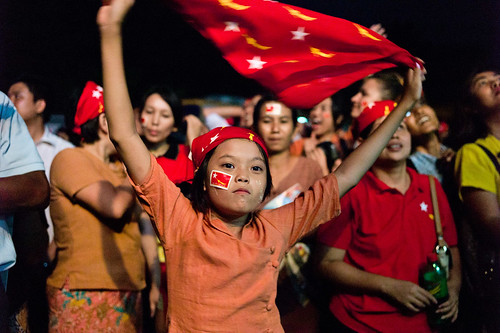
Celebrating election results in Burma

Like most of you I suspect, I've been watching developments in Syria becoming more and more distressing, feeling more and more powerless and hopeless with every new horror. In particular I wonder how it is possible for individual Syrian soldiers to justify to themselves the torture and murder of the entire families of those suspected of taking part in the movement against Assad. The Arab Spring has dealt us hope and despair in equal measure. No doubt even in the more successful revolutions, such as in Libya and Egypt, there will be a period of adjustment where scores are settled more or less brutally, before some semblance of true democracy and law assert themselves. But then it seems the newly liberated weaponry from Libya is finding its way down into neighbouring (and previously relatively calm) countries like Niger and Mali and into the hands of people who want Islamic states in those places.
They seem to have not been so much in the news lately, but I assume that the horrors we hear about in the Congo and Sudan, Liberia and Sierra Leone are still going on. Somalia and Yemen are still in a state of brutal anarchy, home to pirates and terrorists of various kinds, and there's The Lord's Resistance Army still in action, though not so much in Uganda apparently, but still in neighbouring territories.
It goes on. Iraq and Iran of course, the situation in and around Palestine, and what is going on now with the Kurds? Human rights violations, genocide, crimes against ethnic minorities, women and gays. Is there still conflict in the Caucasus or is it quiet there for the time being? Pakistan and Afghanistan, Kazakhstan... And in the background of course, the influence of greater powers; China, Russia, the EU, the US, selling arms, occupying, spying, meddling, manipulating... The threat of terror around the world, totalitarian regimes - Zimbabwe, Burma and North Korea most obviously and other administrations of 'questionable legitimacy'. Saudi ArabiaIndonesia, Venezuela, Haiti, Colombia, Malawi, Russia, Mexico... Preventable disease, malnutrition, homelessness, joblessness, statelessness and crime. And these are just examples that spring to mind. There's loads more of course. I get the news mainly from BBC Radio 4 and pick up bits from The Times and The Guardian, plus postings by helpful Friends on Facebook, and there's always more going on behind the scenes that we never hear about, or not unless you do a lot more delving than I have time for. Actually I don't spend too much time on it because the sense of helplessness in the face of so much cruelty, cynicism and just plain stupidity is too overwhelming. I know it goes on but I mostly feel there's nothing I can do about it. The minutiae do not intrigue me. I only have the one life. I grow plants. I cook. I lie in bed and watch DVDs. I know I'm lucky. My life is a breeze by any standards. But I know how bad it is out there. I don't need reminding. And in a way it's hardly even worth saying. We all know what it's like 'out there'. We all have our own personal pet examples probably but we all broadly agree that there are terrible things going on in the world (and I haven’t even mentioned the environment yet) and we're all horrified and we'd all like to see things being done differently somehow. Where I suspect though that we might part company is about whether things are getting worse. I'm not convinced. In fact in spite of all of the above I am quietly, guardedly, perversely, optimistic about the future. 
How about that?

It's an odd position to be in. I've contributed to a couple of debates on Facebook recently – one with Paul about Bankers’ pay, one with Dominic about Afghanistan – nothing very unusual about either of those topics you might think, but in both cases I seem to have been exposed as some sort of heretic. There seems to be this thing that I’m just not really supposed to say. I get derision and outrage, but mostly I get, well, silence. End of debate.
My heresy is that, despite everything I've said above, things are in many ways a lot better than they used to be. I'm not talking about all the fun you can have with your new gadgets or on the internet or the fact that I can buy decent coffee in my local supermarket (although that last one is very important). I mean big things, important things, things about war and poverty and justice. I’m saying that in many ways things are substantially better now than they used to be.
Why is that so hard to countenance?

For a start, moaning is fun. I’m pretty sure it was R.D.Laing’s book 'Knots' that had a chapter called 'Ain’t It Awful'. It goes like this - Put any two people together long enough and sooner or later they’ll start playing ‘Ain’t it Awful’. Someone will say something about the state of the world these days – how frightening it all is, how useless, how much worse than it used to be, and they’ll be sighing and tutting and shaking their heads – it’s one of those conversational dances we get into – ‘setting the world to rights’ as we say around here. The regulars at the bar do it, the students in the refectory, the old geezer at the bus stop, Friends on Facebook, me and my Bro. We’ve all done it. It’s sort of satisfying and agonising at the same time. Right-wingers are as guilty as Left. Old-style Conservatives tend to talk about how things used to be so much better at some point in the past, Lefties like to talk about how things should be so much better by now. (New-style Conservatives don't care as long as they make money out of it.) But it's all talk. We’re not planning on actually doing anything about it. Basically we’re just enjoying having a good old bitch about things, and, in the case of the left-wingers, showing off how well-informed we are into the bargain.
So, about these debates on Facebook – these can actually get quite involved, usually stemming from someone posting some news article or other, and the people are generally quite well-informed, coherent thinkers, but in these cases the debate quickly turned to pessimism, misanthropy, cynicism, hopelessness, bitterness even, and I had to ask - If you don’t think anything can ever change, why on earth are you bothering to post these articles? What’s the point? Isn’t it just one big game of Ain’t It Awful? (And isn’t your silence just a reaction to my not playing by the rules?)
One response from Dominic, to his credit, was “As much as my own work may be pissing in the wind, I will continue to piss into that wind so long as I have piss to piss.” The situation may be hopeless but he has to try. I can respect that, but I’m not so defeatist. Paul said I was just navel-gazing.
My position, my heresy then, has been to suggest, as politely as possible, that things are not so hopeless, and that things can be changed, or, more importantly, that things have been changed for the better – that we have changed things. Us humans have changed things for the better. 
More precisely, my point would be that to know whether something is possible, it’s useful to know whether anything like it has been done in the past. You need a precedent. If not then you really are a navel-gazer. So do such precedents exist? Or am I totally deluded?

That little fragment – ‘these days’ is crucial to the game. I hear it not just from my Friends but also in the media, where supposedly expert commentators tell us repeatedly how dangerous the world is these days. ‘In this dangerous world we live in...’ they say as if it’s just taken for granted that this is an unusually scary period to live through. ‘Compared to what?’ I shout. What other time in history are you thinking of that was better than now? Have you done any history whatsoever? 
Admittedly up until recently this was a rather subjective assessment, based only on my layman’s understanding of history, but it seemed to me that you didn’t actually have to know a lot about history to appreciate how unrelievedly horrible the world has been to appreciate the way things are now, even including the contemporary horrors mentioned at the top. The way things are now in Afghanistan and Syria, Sudan and Somalia are the way things used to be everywhere, all the time, but most places aren’t like that any more. That much seems obvious to me.
Even just in my own lifetime the whole of Eastern Europe and much of Asia belonged to Russia to do with as it pleased. Russia at the time was in a nuclear stand-off with the USA and its allies, the failure of which could have cost the entire world its life. South-East Asia and Latin America were by-words in revolution and military dictatorship. Africa was a continent of warring nations, some armed by the USSR, some by the USA, and its crowning glory was the apartheid regime. China was like North Korea is now. Nobody went back-packing in Cambodia or Chile. Nobody went to China or Czechoslovakia to make money. Only that vast block of land from central Asia, south through the Middle East and into northern Africa remains in pretty much the same state it was in then, give or take. And before the Cold War there were the World Wars, and before them the Imperial wars and the religious wars, and the wars of conquest and pillage through the middle ages and back and back into prehistory. And it must be remembered that the nations that were conquered and enslaved by the Europeans were not peaceful indigenous kittens before we so rudely interrupted. The Noble Savage is a myth.
Through most of human history it has been taken for granted that the vanquished peoples in any war would be massacred, raped, tortured or sold into slavery – all of them- women and children and farm animals too. Within societies, religious, racial and sexual minorities could be abused with impunity most of the time, and misfits imprisoned, tortured and executed on the slightest pretext, often for public amusement. Women belonged to their men folk to do with pretty much as they pleased. Child abuse was pretty much a fact of life. Of course all these things still go on but hardly anywhere are they considered normal or acceptable, even where they are still common. These days human rights, civil rights, women’s rights, democracy and a just and dependable legal system are things most people throughout the world expect or aspire to. No matter how badly applied those principals are, or how powerful the fundamentalist or totalitarian backlash, it is completely new in the history of humanity that these principals are so widely considered to be the things to aim for.

Up until recently I’d have had to admit that this was very much a personal impression. I’m not a historian and have only a rather patchy knowledge of what has gone on. Recently though I’ve come across a couple of books that have made me think that I might be onto something – The Angels of our Better Nature by Steven Pinker and Why the West Rules (for now) by Ian Morris. Both have their flaws but one thing that one can’t fail to be impressed by is the sheer magnitude of the horror described in both. Up until recently I don’t think I’d quite grasped the sheer intensity or the immensity of the brutality, or its frequency, in conquests, crusades, civil wars, invasions, inquisitions, and just as a routine part of life.
Pinker’s book is no gratuitous gore-fest though (although I found some of his chapters unfinishable*). His central point is that the quantity of brutality and death in the world has steadily declined over time. This may seem preposterous when we think of the carnage of the First World War or the Holocaust, Stalin’s Russia or Mao’s China, but taking into account the sizes of the populations involved, Pinker claims that there are any number of genocides, wars, invasions and persecutions, going right back to the beginnings of recorded history, that far outrank them. If Pinker is even mostly right then that would be a remarkable claim. There are all sorts of objections to Pinker’s methods of course – whether one tenth of the population of Europe (numbering in the millions) being killed in the Second World War can be compared with an entire nation (numbering in the thousands) being wiped out in some battle four thousand years ago for example, but I think the basic premise holds. When we talk about how dreadful the world is these days, we really don’t know what we’re talking about.
The point in any case is not to belittle the sufferings of those who are killed and tortured today but instead to not underestimate the terrible experiences of all those people in the past. I know it doesn’t help to tell someone being tortured in Syria today that there are in fact far fewer in her position than there have been at any other period in history, any more than it helps to tell a woman who has just lost a child that infant mortality is way down. In fact it seems like adding insult to injury (Why haven't I benefited from this improvement?) but it is still worth knowing. It means something. It means there is hope for the world. Why wouldn’t a person want to know that?

My guess is that you are still squirming. Maybe you think my view of the past vs. the present is simply wrong. Well as I said I am not a historian and I can’t justify taking up any more space here with what I have learned of the subject, but I suspect there may be other, more subjective reasons for your resistance and these need clearing away before you decide that it’s simply my understanding of history that is at fault.

Your first impulse might be to question my motives. Perhaps you assume I must be very naïve, or complacent or cynical. I hope what I’ve said at the start deals with the accusation of naivety and previous postings here should tell you how complacent I am about the way the world is run (and if you still think I’m complacent skip ahead to the penultimate paragraph - the one that begins ' But to end on a darker note...') Remember, I’m the one arguing for change here. I'm not the one throwing up his hands and saying nothing can be done.
But I can see that it would suit business to draw attention away from oppression and exploitation in countries where they want to trade. Probably trade does to some extent promote peace, but however businessmen and politicians might like things to appear, that doesn’t change the way things actually are. If things genuinely are better I’m not going to deny it just because I don’t like capitalism. I might want to refine my definition of ‘better’ (see that penultimate para.) but Less Violence does seem 'better' to me, by any definition.
In any case, ‘The West’ isn’t a small part of the world any more, and it’s not the only place women work and have the vote, where children are not just cheap labour and people are not just routinely picked up off the streets for speaking out. It's not perfect - of course it's not perfect. It never will be. It's more like crime fighting, or medicine - always having to deal with the next thing, never winning outright. But it's also about knowing that if we give in, then things certainly will get worse. 

For those among you who have not given up, the activists and the radicals, your main objection will probably be that people are best motivated by rage, and any good news is bound to, to some extent, defuse that rage and make us complacent; as if the only way to motivate people is to feed them an unremitting diet of misery, without ever conceding that anything good can happen.
Well, maybe it’s a matter of temperament but I find that knowing about past successes gives me courage. Good news makes me more likely to try, not less.

Something that certainly makes me gag, as a Leftie, is conceding that any genuine good can come from capitalism or party politics. We want change to come in a truly popular movement. Any suspicion that businessmen or politicians have had any part whatsoever in reform (or worse, stand to gain from it) is taken to compromise or even invalidate those reforms. I’m as suspicious of the free market as anyone, but the idea that true reform has to be totally untainted by vested interests or politics is probably very naïve. There’s a certain brand of revisionist history here that dismisses all past reforms as only those which suited the Market or the government. Certainly capitalism has a way of cashing in regardless, and obviously trade is easier where there is no unrest, but I’m not at all convinced that women’s rights or the abolition of slavery happened only because it was good for the market. Legislation on child labour, environmental standards and working conditions for example, are not at all popular with businessmen. The changes have been made, I think, to a large extent because people believed that change was right, and also that it was realistic. I don’t care too much if the bosses and the politicians want to take some of the credit when things get done, as long as they get done.

But to end on a darker note...
My real fear for the future is not about violence or oppression.
My guess is that the world will get progressively less violent, less oppressive, less dangerous, as it has done (I think Pinker is right here) consistently since the beginnings of human history. I think what some of you disparagingly consider ‘Western’ comforts (democracy, the rule of law, women’s rights, labour regulations, environmental regulations and so on and so forth) will spread. What’s happening in that broad swathe of brutality that runs south from Kazakhstan through the Middle East to Central Africa, where despots rule over countries with violence and fear will come to seem very archaic. Likewise the idea that foreign governments might think it a good plan to go in and try to run those countries for their own ends by force will also come to seem very strange.
What I fear might happen in this newly pacified world is that corporations will continue to become larger in size and fewer in number and quite quickly become too big to be much bothered by governments. It’s already happening. Their impossibly rich managing directors and chief executives will be beyond democracy and national laws and they will be able to do whatever suits them. Government will become a technocratic appendage at best, organising those things it is not profitable enough for the free market to bother with. Eventually everything that does not produce the maximum possible return will stop happening altogether. In the mean time most of our descendents won’t even notice. They’ll work long hours doing mindless jobs but they’ll have their entertainments and their gadgets to keep them quiet. There will perhaps be a kind of intrinsic Third World in each region - trailer parks and slum estates, providing cheap labour, as there are in the USA now. Government and indeed the concept of the nation-state will come to seem like a very quaint anachronism.
I always thought Brave New World was a more plausible dystopia than 1984. The idea of Big Government running the world is already coming to seem very 20th Century.

So that’s what I think we’re really up against. Anyway we need to remember that kings do not rule by divine right any more, and it is not normal to own slaves or to have dissenters disembowelled in the town square. That’s true not because of something the government said – it’s because people decided not to live that way any more.

And if I am wrong about the history? Well, in the words of a good friend of mine:
‘Naïve then, but really, I just can’t bear the idea that we’re just going to go on as we have, the human race I mean, contaminating the place, torturing each other, for ever. I can’t. I just have to believe we can do better than that. I suppose it is like an article of faith with me. I have to believe in it.’ 


* I don’t usually like to recommend Further Reading in my blog because I like to think I can get the salient points across without it but in this case (and whatever you may think of other things he has said) I can entirely recommend having a look at at least the first few chapters of Pinker’s book http://www.stevenpinker.com/publications/better-angels-our-nature. (I actually had to return it to the library before I’d finished it so I don’t know what his conclusions will be, but that doesn’t alter the power of those first few chapters.) Morris’s book http://ianmorris.org/whythewestrules.html is also problematic in its method but I don’t know of another book that provides quite such a huge perspective on the history of both ends of Eurasia simultaneously.